
Video: Was Carrum’s CEO the Voice of Reason at HLTH?
Sach Jain, the CEO of Carrum Health, which helps self-insured employers manage their surgical care costs, had a sobering perspective at HLTH, a conference that celebrates innovation in healthcare.
Sach Jain, the CEO of Carrum Health, which helps self-insured employers manage their surgical care costs, had a sobering perspective at HLTH, a conference that celebrates innovation in healthcare.

Avia CEO Linda Finkel has had many conversations with health systems executives about why their technology initiatives haven’t gone as planned in the past. Based on these experiences, she has noticed four main reasons hospitals don’t see the results for which they were hoping — including not exercising enough scrutiny during the vendor selection process and failure to think about capability at scale.

Enterprise EHR boosts scalability, interoperability, and governance for large healthcare systems.

Save the date for INVEST 2023, which will take place on May 22-24 at the Ritz Carlton hotel in Chicago. The conference unites novel startups with active investors, highlights payer and provider perspectives, identifies challenges and opportunities in the life sciences, and describes healthcare's overall transformation.

Houston Methodist is opening a new innovation hub at the Ion, a 16-acre innovation district established by the city of Houston and Rice University. The health system will use the space to partner with local talent to develop new digital health tools for its eight smart hospitals.

It’s common for health systems, which feel pressured to innovate but are unsure how to implement change, to choose flawed approaches. Having a thoughtful strategy for success can make all the difference.

To follow in the footsteps of the European Renaissance, healthcare leaders and clinicians need to drive the creation of a revitalized delivery model that works for all patients, not just those with greater means.


Veradigm examines key clinical trends, comorbidity profiles, and treatment trends across adolescence, reproductive years, and peri-/post-menopause. Download it today!

Primary care has demonstrated remarkable resilience in spite of the intense pressures of the pandemic, and there is critical work to do to help our nation recover from the wide-ranging consequences of Covid-19.

They have often been hailed as the saviors that could free the nation from the problems of our dysfunctional, inefficient and archaic healthcare system. The reality is that these organizations continue to fail in their initiatives, ultimately stifling true healthcare innovation.

At an event styled after the TV show but kinder and gentler, OSF HealthCare employees get 15 minutes to pitch their ideas to subject matter experts, stakeholders and other members of the community. They use the presentation to share where they are in the process and what resources they need to validate their concepts and network.

Healthcare organizations demonstrated tremendous vision, innovation and flexibility as they navigated unprecedented challenges brought on by the pandemic. However, the challenges and changes to the healthcare industry will continue long after Covid-19 disappears.


Discover the top AI-powered EAP providers for 2026. Compare platforms like Kyan Health and Spring Health on triage speed, global reach, and clinical quality to transform workforce wellbeing.

At every state of development, the unique complexities of the healthcare industry stall progress. Innovators can start by partnering with existing entities that already have robust access to healthcare expertise, distribution, networks and funding, along with demonstrated capability to conduct real-world pilots.

Why start with innovation? Because it’s where the products, tools, solutions, and ideas that will change the status quo are born. Without diversity of thought, experience, and perspective, the end result of innovation only serves those already at the table.
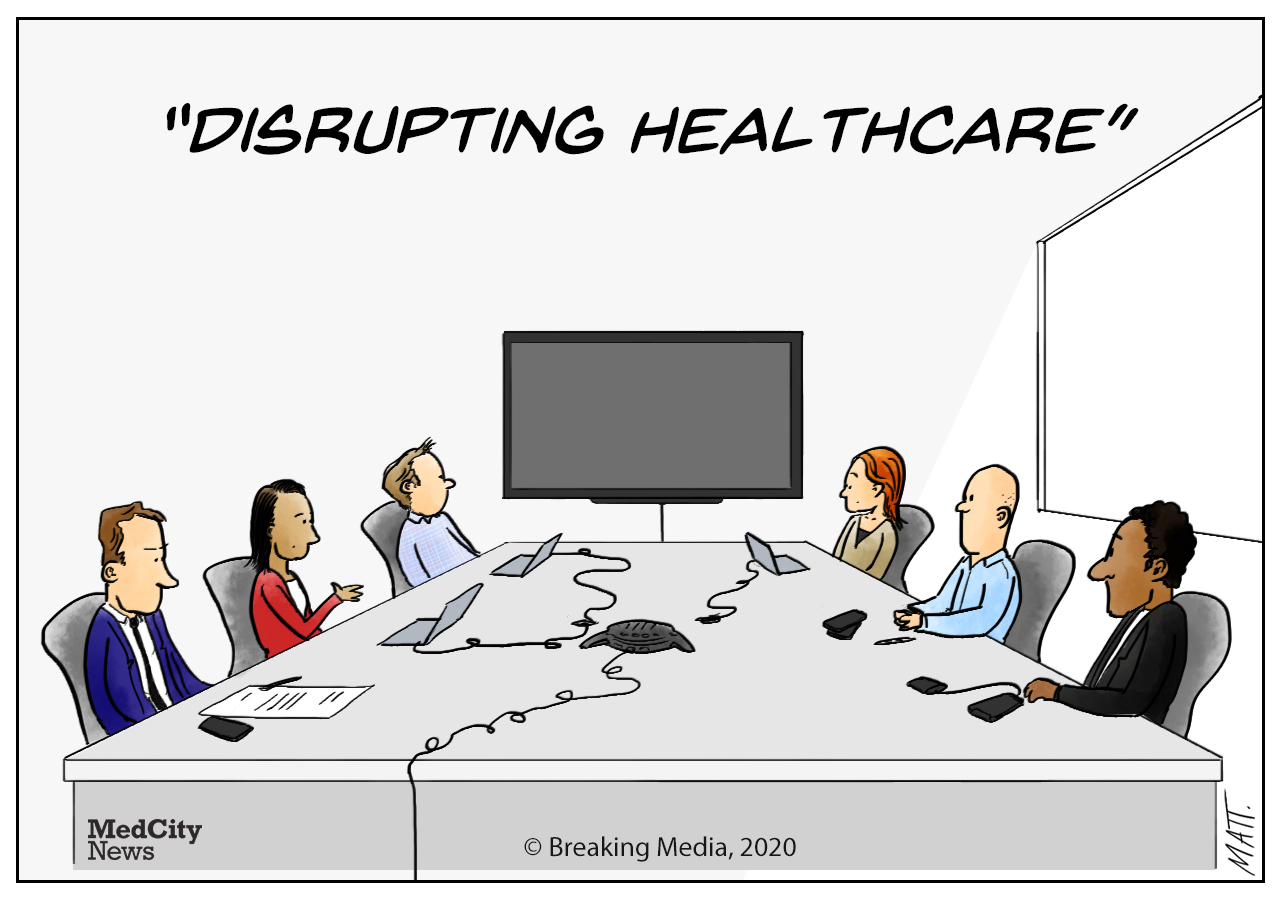
Our weekly cartoon takes an ironic look at self-described healthcare disruptors.

Highmark Health is turning its internal VITAL Innovation program into a commercial offering meant to help startups test their products in real-world clinical environments.

Part of the Department of Health and Human Services, DRIVe is hunting for new technologies to detect and manage infectious outbreaks, control the rampant inflammation associated with sepsis and generally advance health security.